
Anyone participating in a cleanroom project for the first time will inevitably ask this question: Construction is finished, equipment is installed, the lights are on, and air is flowing. The entire cleanroom looks ready for use. Yet, the project is not handed over immediately. Instead, the HVAC system is set to run continuously—sometimes for two to three days, sometimes even longer.
In the industry, this process is commonly referred to as the air purge cycle, system purging, or air flushing.
This brings up an obvious question: There is no ongoing production and no personnel operating inside the room, so why run the HVAC system continuously?
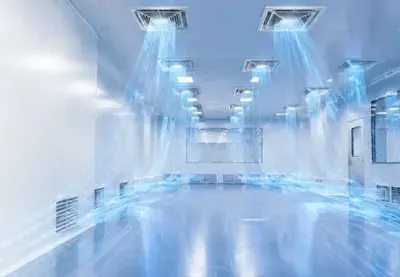
Some believe it is simply to blow the dust out of the room. While not entirely wrong, that explanation only covers half the truth. The real purpose of the purge cycle is not just to "blow the room clean," but to allow the entire cleanroom system to gradually reach a stable operating state.
Clearing Up the Misconception About Construction Residue
Many people harbor a fundamental misunderstanding about cleanrooms. They assume that as long as construction is completed and a thorough deep-clean is performed, the space should naturally meet cleanliness standards.
In reality, the end of construction does not mean contamination has vanished.
Processes like wall panel installation, duct connection, equipment mounting, and electrical wiring all generate massive amounts of microscopic particles. Some settle on the floor, some adhere to equipment surfaces, and many enter the interior of air ducts, plenum boxes, and the HVAC system itself. A vast majority of these particles are entirely invisible to the naked eye.If the facility is put into service immediately, these residual particles will be re-introduced into the clean area by the supply airflow, directly compromising future cleanliness levels.Therefore, before official handover, the cleanroom’s air supply system must run continuously. As air continuously recirculates, the filters capture suspended airborne particles, and residual indoor contaminants are progressively reduced through each air exchange cycle.
This process is far more than a simple "air blow." More accurately, it is a final, systematic "clearing of the stage" for the construction environment using the complete air purification infrastructure.
Why Isn't a Few Hours of Running Enough?
One might ask: If continuous filtration is happening, isn't a few hours of operation sufficient?The real-world situation is far more complex. Air inside a cleanroom is not static.
Microscopic particles accumulated during construction can linger in air ducts, equipment interstitial spaces, ceiling voids, return air risers, and on various equipment surfaces. Once the HVAC system starts, airflow patterns begin to form, progressively sweeping these dormant particles into the air stream where the filtration system can capture and eliminate them over time.
In short, contaminants do not magically disappear the moment the air conditioning turns on; their removal requires a sustained, multi-cycle process of continuous reduction.This is precisely why most projects schedule continuous, multi-day operations rather than shutting the system down after just a few hours.
Establishing System Stability and Operational Parameters
Beyond purging construction residue, the air purge cycle serves another critical—and often overlooked—function: bringing the entire HVAC system into a stable operational state.
For a cleanroom, cleanliness is not the only parameter that needs to stabilize:
Is the supply airflow reaching design values?
Have inter-room pressure differentials been established and balanced?
Are temperature and relative humidity remaining steady?
Is the automated control system capable of uninterrupted, continuous operation?
All of these parameters require time to settle. If validation testing is conducted immediately upon system startup, the collected data rarely reflects normal operational performance.
Therefore, prior to official testing, the system is allowed to run continuously for a set period until all operational parameters stabilize. Only then are airflow volume, differential pressure, and airborne particle count tests conducted. The data gathered under these conditions is truly representative.
Purging vs. Cleanliness Compliance: A Crucial Distinction
It is vital not to confuse the purge cycle with cleanliness compliance—they are two entirely different concepts.The air purge cycle is merely the process of systematically reducing construction-phase contamination and stabilizing system performance. Whether the room ultimately satisfies design requirements must still be verified through standardized testing and commissioning.
For instance, cleanrooms of different classes must undergo airborne particle count testing; certain projects also require microbiological sampling, airflow velocity/volume measurements, and differential pressure validation. Only when all test results strictly meet design specifications can the cleanroom be officially commissioned for use.
The Engineering Logic Behind Risk Reduction
HEPA/ULPA filters are typically installed at the very last stage of construction specifically to prevent heavy dust loads during build-out from prematurely consuming their service life.
The air purge cycle, on the other hand, takes place after HEPA filters are installed, running the complete air purification system to progressively eliminate residual construction contamination.
The former protects the filters.
The latter harnesses the power of the filters.
Both serve the exact same goal: ensuring the cleanroom reaches a fully controlled, design-compliant state before going live.
Many construction procedures may seem overly tedious at first glance: Why install HEPA filters last? Why run a continuous multi-day purge cycle? Why refrain from rushing the handover before testing?Once you understand the engineering logic behind these steps, you realize they are not added to increase workload—they are designed to mitigate risk. Because what a cleanroom project delivers is never just a finished room...
It is a system capable of long-term, stable environmental control. That is the single fundamental difference between cleanroom engineering and standard interior fit-outs.