
During cleanroom construction, there is a step that is frequently overlooked by those new to such projects. Once HEPA filters are installed, the job is not immediately complete. An essential check must follow: leak testing.
When hearing about this for the first time, many people wonder: Aren't HEPA filters already fully manufactured? Didn't the supplier perform factory testing before shipping? Why do they need to be re-tested after on-site installation?
There is a critical distinction here that is easy to miss: A filter being compliant on its own does not mean the system is compliant after installation.
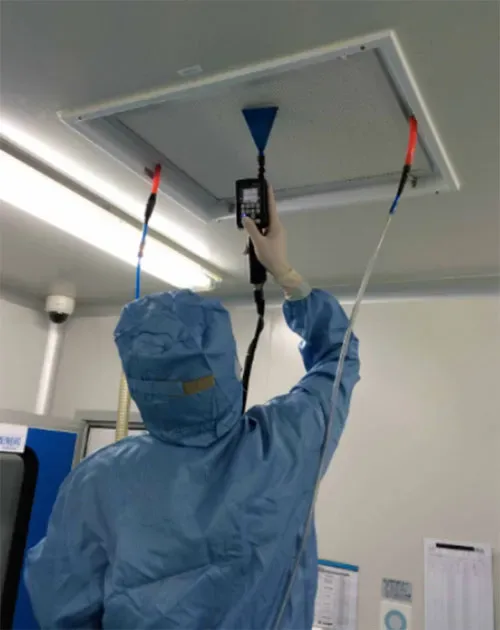
It's Not Just About the Filter—It's About the Entire System
Most people are familiar with the function of HEPA filters: as air passes through, the filter media intercepts airborne particles, allowing the supply air entering the cleanroom to meet design requirements.
However, air in a cleanroom does not pass solely through a sheet of filter media. From the ductwork to the plenum box, to the filter mounting frame, and finally into the cleanroom—there are numerous connection points along the way. A defect at any single point can compromise the end result.
HEPA filter leak testing does not inspect the filter alone. More importantly, it verifies whether the entire terminal air supply assembly remains reliably sealed after installation.
The "Bypass" Risk: Why Sealing Matters
It is easy to view a HEPA filter as a standalone piece of air purification equipment. But in a cleanroom, it actually serves as the final barrier in a system.
Air may undergo multiple stages of treatment before reaching the filter. But at the terminal supply point, the HEPA filter bears the ultimate control responsibility. If the filter media itself is flawless, but a gap exists in the surrounding seal, a portion of the air can bypass the filter media entirely and enter the cleanroom directly.
This bypassed air has not undergone effective filtration. In a standard indoor environment, such an effect might be negligible. But in a cleanroom, any uncontrolled airflow introduces significant risk.
Why Do Leaks Occur?
The reasons for leaks are straightforward. Proper filter installation requires:
Reliable, uniform seating between the filter and its mounting frame;
Continuous and intact sealing materials (e.g., gaskets or gel seals);
Correct installation orientation;
Fastening methods that comply with specifications.
During construction, improper installation or incomplete sealing can easily leave hidden vulnerabilities. These issues cannot be fully detected by visual inspection alone, which is why professional testing methods are required for confirmation.
The Engineering Logic: Product Quality vs. Installation Quality
There is a compelling engineering logic at play here. Experienced cleanroom engineers know that while a HEPA filter’s filtration efficiency is paramount, installation quality is equally critical on-site.
Consider a high-performance door:
The door itself may be flawlessly constructed.
However, if gaps exist around the door frame, its soundproofing and protective capabilities will still be compromised.
HEPA filters follow the exact same principle. No matter how high a filter’s performance rating is, if the installation seal is inadequate, it cannot deliver its designed performance.
The Purpose of Leak Testing
The core objective of leak testing is to confirm through empirical measurement:
Is all air passing through the intended filtration path?
Are there any leaks or tears in the filter media or frame?
Are there any defects at the sealing locations?
Does the installed system meet design specifications?
Ultimately, leak testing validates whether the cleanroom's final line of air control defense has been truly and reliably established.